

My first job…

One thing that fascinates me about social media is the fixation on generational stereotypes. I can’t count the number of videos about GenX I’ve watched portraying them as the unsupervised generation—sent out into the world without a cellphone and bottle of water, allowed to stay out until the streetlights came on, while drinking water from the hose spigot, and hustling to get jobs to make money. 

Whenever I hear the boasting of the rough and tumble GenXers, it makes me giggle, because I think about my own childhood. While I didn’t walk six miles through the snow to get to school like my grandparents might have boasted, I did drive myself six miles across the lake each day to get to school—from the age of fourteen to seventeen—in a leaky boat I had to bail out each morning, and once started to sink on the way home. It had no windshield, which made winter traveling especially cold. I had no cell phone—heck, my family didn’t even have a landline. They had an unreliable mobile phone in their truck, with multiple party lines.  And if I didn’t make it to school in the morning, they wouldn’t know until I failed to return home that night.

One trend for some GenX videos is to ask that generation to share the age they were when they got their first job—and what that job was. Those videos got me to thinking about my first job, after all, I am a boomer and isn’t it all about us? LOL. But before I tell you about my job—let me set the scene.

For my first thirteen years I lived with my family of four in Covina, California, a suburb in Southern California. Back then, it was a predominately white community. Residents tended to live in housing tracts —where all the houses were similar in floorplan and built by the same builder—think Leave it to Beaver neighborhoods.  Some lived in apartments—and other lived in custom homes, the latter being considered the more upper class of the suburb.

My father was a general contractor, and the two homes we lived in during our years in Covina were custom homes, both designed and built by him, and located on large lots in what was considered one of the more exclusive areas of Covina. My older sister drove a MGB sports car. Our parents said someday we could get a horse.

But then Dad had a crazy dream, and Mom, my sister and me went along with him. My parents became the major shareholders—and managing partners—of Havasu Palms, a resort aka park located on Lake Havasu. 

My sister’s MGB was sold, we never got the horse, and we all moved from our beautiful Covina home into a ten-wide travel trailer (no, it was not a mobile home) at Havasu Palms. Our Covina house was eventually sold, and Mom, now no longer a stay-at-home-mom, worked alongside my father to build his dream.

The park was initially located on government lease land and comprised of 27 travel trailer sites, a campground, boat docks, primitive store and marina. The lease land was located on 4 ¼ miles of shoreline on the California side of Lake Havasu and was located twelve miles north of Parker Dam, California—with the only access road into the park being a dirt road that wound through washes and was vulnerable to flash floods. It was six miles south—by water—from Lake Havasu City, Arizona.

There were no phone lines into the park—so my teen years were spent without a landline OR cellphone. At first there was no television, but after Dad put up an antenna, we got three stations from Lake Havasu City. Three stations—ABC, CBS, and NBC. 

My parents were busy implementing Dad’s dream to develop the resort, which meant they couldn’t spend all their time working at the park’s little store/marina.  In the early years, that task fell on my older sister and me.

I was thirteen when I first started working at Havasu Palms’s store. I worked weekends, and summers, until my last year of college. The year between my junior and senior year of college, my mother told me I could take the summer off—something I have always been eternally grateful for. 

This may surprise you, but it was totally legal for me to sell beer at the store when I was thirteen. If it was not opened, I could sell it.  I worked primarily alone at the store—no supervision. There was no bathroom, so if I needed to use the bathroom, I had to lock up the gas pumps and store, walk up the hill to our trailer, which was located on the future site of the Road’s End Restaurant. 

The store building included three sections, with the icehouse on the end near the road. Sandwiched between the actual store and icehouse was the bait room with the minnow and waterdog tanks. The primitive building was made from recycled material, with a tin roof. The store was cooled by a rusty swamp cooler. And considering Havasu heat, swamp coolers are useless in the dead of summer. Fortunately, there was a large tamarisk tree helping to shade the store, and Havasu Palms temperatures tended to be about ten degrees cooler than across the lake, at Lake Havasu City. There was also a large rock patio in front of the building where people gathered to visit. 

What were my duties? I rang up sales on the cash register in the store. The store offered bait, ice, gas, propane, beer, soda, water, sundries items, candy, ice cream, cigarettes, some frozen meat, and the type of groceries you might find at a gas station store.  

 We didn’t have fancy registers back then, so I learned to count back change the first week I worked the store. I pumped gas at the gas docks and on the road. I would sometimes go into the icehouse and cut 100 pound blocks of ice into four 25 pound blocks.  I would scoop up minnows and waterdogs for fishermen and dump out the nightcrawlers and red worms into a metal container, to make sure they were still alive before selling, and then dump the worms back into their original containers. We rented out fishing boats with little engines that you had to pull start, so I would have to show the renters how to use the boats.

I sold fishing licenses, stocked the store, and played store janitor. One thing my dad didn’t have me do—I didn’t fill propane tanks for our tenants. 

Because of the Havasu heat, during the summer my sister and I often worked in our bikinis. When we got hot, we would jump in the lake off the docks and cool off. Because of the heat, we would be dry within minutes of getting out of the water.  When working the cash register, I’d typically throw on a large T-shirt or summer shift over my bikini.

If it was a holiday weekend, the store could be super busy, and that would usually require more than one person working and hiring extra people to work the gas docks. But on other days during the summer, we could go for hours without a customer. On those slower days, after getting the store cleaned and stocking the shelves, we’d find other things to do. Sometimes I would read a book, or float around by the docks in an innertube. One summer, I wrote my first book.

I was fourteen that summer between my freshman and sophomore year of high school; I took my old manual Royal typewriter down to the store, and when not waiting on a customer, I worked on my book. I finished it that summer. It was just under 100 typed pages. It’s title, The Privileged Ones.

Early on, my father found an old wooden juke box in one of the outbuildings. He brought it to the store and set it up on the porch. My sister and I loaded it with all our 45s (records). We kept any money it made, but it rarely made any, because we would open the back of the juke box, flip all the levers, and play all the songs.

I remember one summer, one of my friends and I learned how to knit.   It must have been a crazy sight to some random customers who just happened off the lake and found a couple of teenage girls wearing bikinis and knitting behind the store counter.

Tenants of Havasu Palms didn’t live at the park fulltime back then; it was their vacation spot. But I became friends with our tenants’ kids, who were about my same age, and we’d hang out together in the summer or on weekends. Some of them, like Tim Loyd, Mike Russum, and Gary Morris, worked for the park at various times over the years. Mike used to hang out at the store with us and taught me how to play the guitar. Well, I learned a few songs, at least, like Puff the Magic Dragon. Tim was like a brother to me, and Gary introduced me to my husband and was the best man at our wedding.

It was a great first job, with lots of adventures and meeting new people. But sometimes I’d bitch and want to go on strike.  If memory serves me, I think I made $1 an hour. But I could have all the candy and ice cream bars I wanted.  

(Photo: Havasu Palms store)

An Author’s Secret…

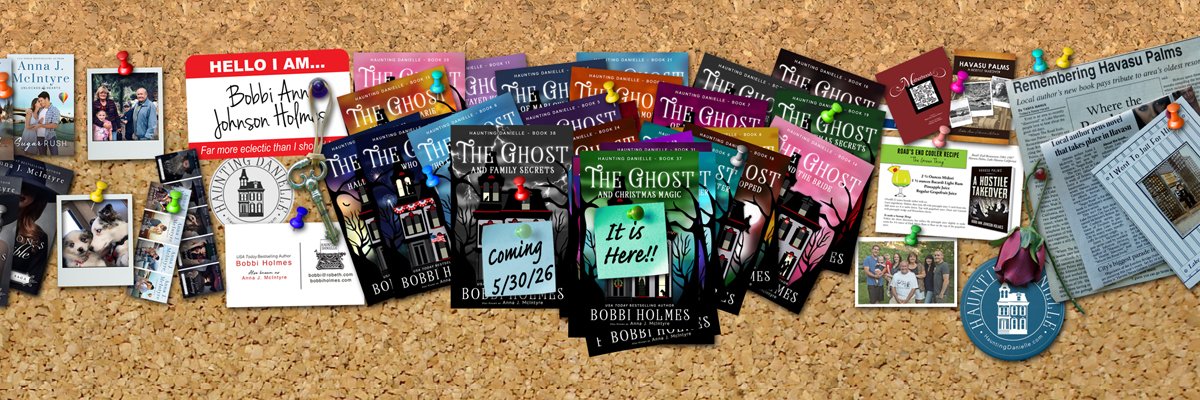
Today I released the 37th book in my Haunting Danielle series, The Ghost and Christmas Magic. It is now available in eBook and paperback format. The audiobook version will be released by Tantor on February 10, 2026.

Yesterday one of my readers reached out to me. She told me she had been checking to see when the current book was being released when she noticed a mention of the next book—The Ghost and Family Secrets, slated to be released May 5, 2026.

She asked…very nicely…if I might give her a bit of a teaser about the book, obviously wanting something beyond the vague book description of book 38.

I couldn’t give her a teaser. Not because it is some grand secret…but because I have a secret.

People often ask writers, how do you get your ideas? I get that question a lot, especially since I have a long series. 

In my last blog post, I wrote about my writing process, and how I often rely on automatic writing to get ideas flowing. But there is something else I do, that I did sort of mention, yet not fully.

My father’s mother, Madeline, was an artist. Occasionally I would stay over at her apartment if my parents needed a sitter. When I was very young, one thing she used to do to keep me entertained, she would take a piece of blank paper, write a squiggle on the paper, and tell me to draw a picture from it.

I enjoyed that game. I’d look at the random scribble and try to figure out what I could make from it. 

I sort of do that now with my books.  As I may have mentioned in my previous post, I always come up with a title for my next book when releasing the current one. That way, I can include a pre-order in the back of the new release.

Often, I have an idea what the story is going to be about. In fact, sometimes I know what is going to happen in the next four or five books.

Yet other times, I have absolutely no idea what I intent to write about. So, I try to come up with an interesting title—and that title is like the squiggle my grandma used to draw me. And from it…I will come up with a story. Basically, the title becomes my inspiration. 

Confessions of an author—where do I get my story ideas?

I’m currently working on my 37th book in my Haunting Danielle series. One question I get frequently, how do you get your story ideas?

Some series have a very structured formula. For example, take one of my favorites, Murder She Wrote. Jessica is typically at some event. Someone is murdered. Jessica investigates the murder. Murder solved.  

If you’ve read several books in my Haunting Danielle series you’ll know, that’s not my formula. While there is always a mystery, there may or may not be a murder, and said murder might have happened years ago. One thing you can expect, ghosts will help solve the mystery, and there are typically several story lines going on simultaneously that come together in some fashion at the end of the story.

Since I released the first book in the series I knew when the next Haunting Danielle book would be published, because I started making each one a pre-ordered eBook. When I sit down to write a book, I need to have it finished in time to meet the deadline set by the preorder. 

There are some new authors—or aspiring authors—who don’t understand how anyone could publish four or more books a year. While I write about two books a year now, there was a time I did four a year. However, writing a book from a series is easier than starting a brand new book. In a series the main characters are already established, and I’ve already done the world building. The hardest part for me is keeping everything straight. 

But how do I come up with new stories? Sometimes, I am mentally plotting several books ahead. In those situations, an idea that comes to me will require foreshadowing before I write it. For example, I needed to write book 14, The Ghost and the Bride, and the books that followed, before I got to book 17, The Ghost and the Doppelganger.   

I don’t always know where the series will take me, I allow each book to lead the way. When finishing up a book, I often come up with a story idea for the next book. Sometimes, I only come up with a title idea. When finishing up The Ghost and Wednesday’s Child, my last release, I looked to see where in time my characters are now living. When first starting the series, they were in the summer of 2014, the same year I was living when I wrote the first book, The Ghost of Marlow House.

While some writers prefer to be more ambiguous about the timeframe of their story; I couldn’t do that as historical events are key elements to the series. It was easier for me to start at a place I was familiar, 2014. However, time moves faster than the world of Haunting Danielle, and they are currently living in 2019.

I decided to make my next book Christmas themed, and have it published the end of November. When looking for a title I chose The Ghost and Christmas Magic. As all my readers know, all the titles in this series start with, “The Ghost…”

Did I have a specific plot in mind when I chose the title and scheduled the pre-order? Nope.

However, I decided, not long after releasing The Ghost and Wednesday’s Child, something I wanted to happen in the next book that I thought my readers would enjoy, and I would have fun writing about.  Unfortunately, it was only a snippet of the plot. I needed more.

When between books I often tell readers I’m currently working on the next book. Yet, that typically means I am thinking about the book, and if a plot or scene idea pops into my head I will jot it down for later.

I typically take about seventy days to write a book. Once I start writing, I write a chapter a day, then the next day, I edit the chapter I wrote the previous day and then write a new chapter. The next day, I do the same thing, rewriting whatever I wrote the previous day and writing a new chapter. At the end of forty days, I have a completed rough draft that has technically been edited once. Then comes the serious editing and rewriting, which honestly is  my favorite part. Before I hit publish it goes through ProWritingAid, two sets of beta readers, and a professional editor. I also reread it, using the text to voice option while reading the text as the robotic voice says the words, before hitting publish.

And no, I never use Ai. While some may argue ProWritingAid is an arm of Ai, I disagree. It only sees my manuscript after it is in essence written, and is looking for misspelled words, punctuation errors, and overused words.

I write my manuscript in Scrivener but move it to Word during its final editing process. Word added an Ai feature a while back, which I disabled when it first appeared. As many of my fellow writers might agree, I found its little Ai cursor incredibly annoying, following me around the page like a freaking stalker.

I am scheduled to write Chapter One for my new book tomorrow. So now the question, am I a pantser or planner? A panster is someone who writes “by the seat of their pants.” They just sit down, start writing without an outline or specific plan. The planner is the writer who first outlines their story before they start writing. So, which am I?

I’m a combination of planner and pantser, with a hefty dose of automatic writing thrown in. To be honest, the automatic writing is one of my major tools. Four days ago, I really had no idea what I planned to write about in The Ghost and Christmas Magic, aside from that one thing I wanted to happen to one of my main characters. 

You may have heard of automatic writing. It has also been called spirit writing, which I suppose is apropos for someone writing about ghosts. Some mediums claim to use automatic writing as a technique to receive messages from their spirit guides or spirits they are attempting to contact.

As for me, I am not sure if I am contacting spirits or just tapping into my inner psyche to unlock my creative side.

This process for me starts with a quality ink pen, not those ink pens you buy in a bulk package, but one that cost over twenty bucks and you change the cartridge when the ink runs out instead of throwing it away.  

I sit down with a pad of paper and my pen and begin writing in cursive, typically beginning by writing about what I already know about the book, which might just be its title. And strangely enough, ideas begin popping into my head, giving me story ideas and a plotline fairly quickly.

Like I said, four days ago I knew very little about this book. However, this morning, I basically outlined the entire plotline. Since my handwriting is not terrific and my writing is even difficult for me to read, I then sat down at the computer and began typing up what I had just written in cursive, typing from memory. 

So, when someone asks me where I get my story ideas, I’m honestly not sure where they come from. I always have this feeling I’ve a muse—an unseen muse—who whispers in my ear when I take a pen in hand and start writing out the plot ideas.