Let me begin this post by saying I don’t believe sexual preference is a choice. I believe you are either born straight, gay, bi, or asexual. I don’t believe it’s something you can control. Those people who sincerely believe it is a choice—those people, in my opinion, are bi. Since they personally are attractive to both men and women and can “choose” to be with the most socially accepted partner, they assume everyone in the world is like that. But they are wrong.
I’m straight. It’s not a choice, it’s just who I am. And I can’t imagine how traumatic it would be if someone told me I had to be attracted to other women—and I was expected to marry and be in an intimate relationship with one. That is why I can imagine how equally abhorrent it is for a gay person to be told the only acceptable intimate partner they can ever have is one of the opposite sex.
Now on to gay pride…
We don’t have straight pride month because straight teenagers aren’t killing themselves at an alarming rate because they are sexually attracted to the opposite sex. It has been reported that LGBTQ teenagers are four times as likely to commit suicide than their peers.
Teen years are emotional and challenging enough without being told you are going to hell because of how you were born.
I also believe a closeted gay man can be one of the most dangerous men for both women and openly gay men. Especially if they are in politics or have another position of power. Why?
A closeted-gay-man is often filled with self-loathing and hate, unable to be what society tells him to be in order to be a “real man.” He turns that self-loathing to openly gay men and other members of the LGBTQ community, resentful they are living their truth. They also turn hate toward women, resentful because society tells him he is supposed to be sexually attracted to them, when he isn’t. Since he can’t control his desire, he seeks to control women in other ways—such as attempting to take away their bodily autonomy, their vote…he wants to control women. That way, he can feel like a “real man.”
But if we allowed people to be who they were born to be—as long as all partners are consenting adults (this goes for straight, gay and bi)—then there would be no reason for the hate and loathing.
Remove the self-loathing and we reduce the number of teens who try to kill themselves, and we reduce the number of men in power trying to take away women’s rights.
That is what pride is about. It is supposed to send a message that they are accepted…Accepted just as God (or the Universe, or however you believe) created them.
I had a little trouble falling asleep the other night, so I decided to put in my earbud and listen to an audiobook and let it lull me to sleep. It didn’t work because I got into the story, and the crazy thing, it was one of mine—Coulson’s Crucible, the second book in the Coulson Family Saga. I can’t remember the last time I listened to the audiobooks. They were released in 2020, and I listened to them multiple times in those first few years.
As I’ve mentioned many times before, when I first listened to the audiobooks, I was blown away with how Reagan West narrated the series. She did an amazing job. I’ve been blessed with two talented narrators—Romy Nordlinger for my Haunting Danielle Series, and Reagan West for my Coulson Family Saga.
But this blog post isn’t really about the audiobooks, or my amazing narrators. It’s about the first book I wrote in that series, Lessons, almost thirty years ago, and what it taught me. The book was eventually retitled Coulson’s Lessons.
Lessons was the first book of fiction I ever self-published. However, it wasn’t the first book of fiction I ever wrote; that would be The Privileged Ones, written during the summer between my freshman and sophomore year of high school. Yet, if I am honest, The Privileged Ones was more a novella.
The next was a mystery, based on a screenplay I had written during college in the seventies. I started rewriting the screenplay into a novel several years after graduating from college. But during the final editing process, I misplaced the manuscript, and while I still had the screenplay, I lost the desire to rewrite the book and finish the project. This was before the era of home computers.
The next novel I wrote was Desire at Chief’s Head, in the early 1980s. A romance heavily influenced by the bodice rippers of that era, and what would now be considered politically incorrect.
In the mid-1980s, I shifted my writing to non-fiction, telling myself that’s where I belonged. I always enjoyed the research and discovery in non-fiction writing. I started a local publication in the small mountain community we were living it at the time, and successfully ran the business for six years, until we moved to Lake Havasu, to help my parents run their business, Havasu Palms, after my father became ill.
I continued to write during that time, even self-publishing a book of local history a few years after my father passed away. But I was now the general manager of Havasu Palms, while my husband was the operational manager. Havasu Palms was a concession on Lake Havasu, which included a restaurant/bar, store/marina, boat docks, and a mobile home park.
Sometime in the mid to late 1990s, I had an idea for a novel. It had been thirteen years since I had written fiction. When starting the book, I leaned heavily on the writing advice—write what you know, when setting up the world in Lessons.
Lake Havasu City, a town founded by Robert McCulloch in the 1960s and where I attended high school, inspired the town of Coulson. Yet, in my fictional town, the Coulson family stays in Coulson, becoming a powerful and wealthy political family. While Coulson is in the southwest, I never mention what state.
The story in Lessons flashes to the main character’s early childhood and back to present-day adulthood, which is why my main character graduated from high school in 1972, the same year I graduated. I didn’t write her this way because she is me—but because it was easier for me, as the writer, to write about an era I had personally experienced from the music to the fashion and current events. Since one of my duties at Havasu Palms during the writing of this book was managing a restaurant, my main character owns a restaurant. Some things I wrote about the main character I borrowed from my life—such as how she had an old red Corvair van, as I did in high school, or how her prom dress looked like the one I wore, those many years ago. Since I’m not a car person—or a fashionista—it was easier to pull that story fodder from my life. It’s one reason I gave Danielle, from Haunting Danielle, a Ford Flex. That’s the car we have.
Of all the books I’ve written—and I’ve written and published over fifty—Lessons was probably the one I had the most fun writing. Once I started writing, I didn’t want to stop. And since I had a full-time job, I wrote in any spare minute I could find.
After listening to Coulson’s Crucible’s audiobook, I decided to listen to Coulson’s Lessons this morning, which is the second book in the Coulson Family saga. My mother always told me Lessons was her favorite book of mine. She had listened to the audiobook many times.
So, what was my lesson after listening to the first eleven chapters of Coulson’s Lessons? I still enjoy the story—however I see a lot of writing flaws I didn’t notice in Coulson’s Crucible. Primarily, head-hopping. But it’s something that could be corrected with some rewriting and editing.
Will I do that? Absolutely not. Because one lesson of Lessons—for me, anyway—perfection often inhibits progression. Let me explain…
I self-published Lessons in 2011, about fourteen years after I wrote it. This was during the early years of what I call the post-eBook era of self-publishing, in my upcoming book, Write On, An Author’s Journey.
I did some self-editing and rewriting and hired a professional editor before pressing publish. I later re-edited the book (without unpublishing) because of issues with the dialogue tags. But I never went back and rewrote the book after publishing.
As I’ve explained in previous blog posts, after publishing Lessons, I soon realized most successful self-published authors wrote series, so I wrote a sequel to Lessons, The Senator’s Secret (now Coulson’s Secret). Since I had fallen in love with my characters, I went back in time, and ended up with a five-book series, a story spanning over a century, with Lessons ending up as the third book in the series and renamed Coulson’s Lessons.
When writing the series this way, it allowed me to give life to events mentioned in Lessons. It was the reason the first book was bittersweet, and not the happy ending a reader might want when picking up a romance.
Coulson’s Family Saga tells a story about the Coulson family and how the family dynamics slowly progress from one generation to the next. The threads left hanging at the end of each book are eventually woven together in the fifth book in the series, Coulson’s Reckoning. When I look at the series, I realize the story was about the women. At first glance, it might seem as if I wrote about a family of powerful men, when in truth, it was about the woman who helped heal and break the toxic cycles and move the family into a happier and healthier future.
In 2020, my agent sold the audio rights of the series to Dreamscape Publishing, and Reagan West brought the story to life with her talented narration. When listening to the series, I still love the story—which might sound conceited, but I’m being honest. However, it is not for everyone, especially those who don’t want profanity or sex scenes in the books they read.
The series addresses such topics as homosexuality, seduction, postpartum depression, rape, sexual harassment, abortion, corruption, infidelity, and grooming. It’s a story that in some ways juxtaposes the patriarchy and matriarchy. There are sex scenes—which I honestly found necessary for the story—and curse words. I don’t believe the sex scenes were gratuitous, and the curse words were realistic for the scenes.
With all that being said, I can still recognize flaws, especially in Coulson’s Lessons. However, the story of Lessons would not change if I took tighter control of the head hopping.
Don’t misunderstand me; I believe self-published authors should take all reasonable efforts to make their writing the best before they hit the publish button. And sometimes it’s prudent to do another edit after publishing, as I did when I realized the issues with my dialogue tags in Lessons.
However, our writing will never be perfect. And the more we write, the more we improve. I’ve seen some writers so obsessed with publishing the perfect manuscript that they spend years writing and rewriting the same manuscript, and never move on to write their second book. There comes a time we need to move on to the next book and accept the imperfections of the previous one.
Tomorrow the 38th book in my Haunting Danielle book will be released, and I’ve no doubt the writing is better than the first book in that series. As it should be.
Coming later this year: Write On, An Author’s Journey by Bobbi Ann Johnson Holmes
I am sitting at my desk in my home office, looking out the window and admiring the flowers planted along the fence line—on Scott and SeAnne’s side of the property. I think of them as my daughter-in-law’s flowers and appreciate that SeAnne planted them in a place where I can enjoy them while I work. Scott probably helped with the planting. They also planted the blueberry bushes along the fence, on our side of the yard. Young, ripening blueberries already fill the bushes.
We’ve made a lot of changes to this property since we moved to Oregon almost five years ago. (It will be five years in September.) One of those changes, we installed a larger window over my desk, and I think it’s probably one of my favorite home improvements.
They told us it rains a lot in Oregon. They were right. Surprisingly, I don’t mind those rainy days because I have a cozy place to write, and even a rainy view is beautiful here. And when I hear about water shortages—especially now with data centers popping up around the country—I am grateful for the rain, and even more grateful for what it does to our landscape.
This morning we woke up to sunshine, not rain clouds. I spent the morning opening the greenhouse, watering the garden and plants in the greenhouse, and pruning the rose on the arch in our backyard. The roses went insane this year. Don and I call them Doris’s roses. Don’s mother, Doris, absolutely loved roses.
Don just finished mowing the front yard, and I can hear him driving the riding mower back to the shop. Next door, Scott and SeAnne are working on projects in their yard—they have the week off.
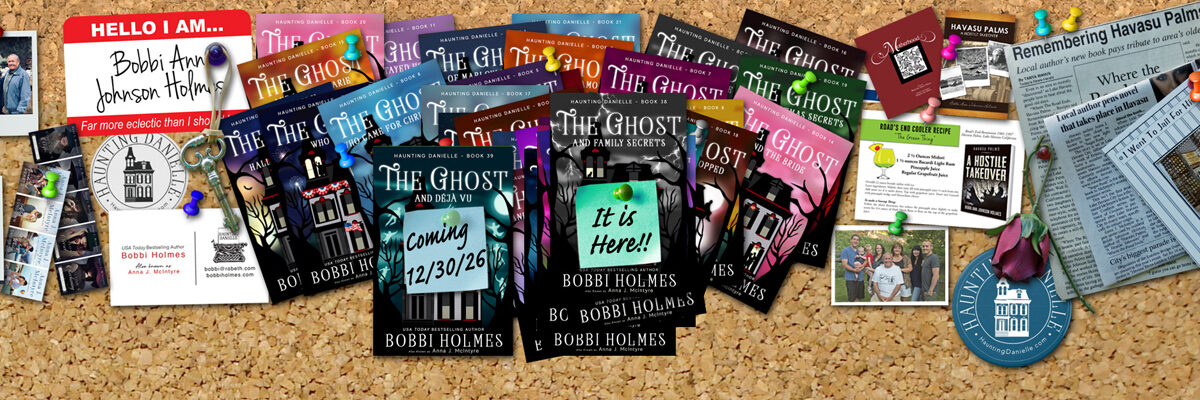
But now I am back at my desk, checking off items from my to-do list regarding my most recent release, The Ghost and Family Secrets, which comes out Saturday in eBook and print formats.
Earlier this week, I sent the document file off to my agent, who will send it to Tantor Media, so they can proceed with making the audiobook. I don’t have that release date yet, but when I do, I’ll pass it on. But for now, I am finishing up what I need to do on my end with The Ghost and Family Secrets, and when June arrives, I will turn my attention to new projects.
One publishing project for 2026 involves releasing all 38 books (and future books) in the Haunting Danielle series in hardback format. We’ve already finished Book 1 in the series, The Ghost of Marlow House, although we haven’t yet offered it for sale. It was basically a trial run to see how we liked the printer. It will be a couple of months before we can complete that project.
One reason we won’t be working on the hardback books in June—my cover designer will be making a major move—from California to Alaska, during this time. As many know, my daughter, Elizabeth, who is a talented professional cover designer, does all my book covers. Her husband is in the Coast Guard, and they are being sent back to Alaska. This will be their third tour in Alaska. When she is settled in their new home, we can proceed with the project.
We have a busy June scheduled. My daughter’s family will stay with us for a little over a week, as they stop for a visit on their way up to Alaska. June is also Don’s and my 50th wedding anniversary. For the last couple of years, Don and I tossed around ideas about what we should do for our 50th anniversary—once considering a party, and another time a Hawaiian cruise. But life had other ideas, so for now, we will enjoy a quiet dinner with just the two of us and do something special later when things settle down.
One thing I plan to do in June is enjoy the sunshine and work in the garden. I will also wrap up Write On, An Author’s Journey, which I started writing in December. It’s a memoir of sorts—both an autobiography and reflections on my writing journey, while sharing with aspiring authors lessons I’ve learned along the way.
It’s tentatively scheduled to be released late summer, and it will be available in eBook, print, and audiobook. No, I won’t be narrating it myself. I’ve had a chronic cough I’ve been dealing with for almost five years, and narrating a book is not in my wheelhouse.
Come fall, I will work on the next Haunting Danielle book, The Ghost and Déjà Vu, Book 39, which is slated for release in late December 2026.
I suppose I’d better get back to my to-do-list. When I’m finished at the computer, I’m heading to the kitchen. Time for some baking.